 Tooter
How to say goodbye in Korean
Goodbye in Korean depends on who is leaving. Say 안녕히 가세요 (annyeonghi gaseyo) to someone who leaves, and 안녕히 계세요 (annyeonghi gyeseyo) to someone who stays while you leave. With friends, say 안녕 (annyeong) or 잘 가 (jal ga).
Practice it with a tutor Learning Korean
- 95.6K likes
- 1.5K comments
- 20.1K shares
 Learning French
- 112.3K likes
- 1.4K comments
- 128.7K shares
 Learning Spanish
- 102.8K likes
- 737 comments
- 22.9K shares
Where will you say goodbye?
Pick one to start your plan. It takes about a minute.
Every way to say goodbye
First ask yourself who is leaving. Then pick the level that fits the person.
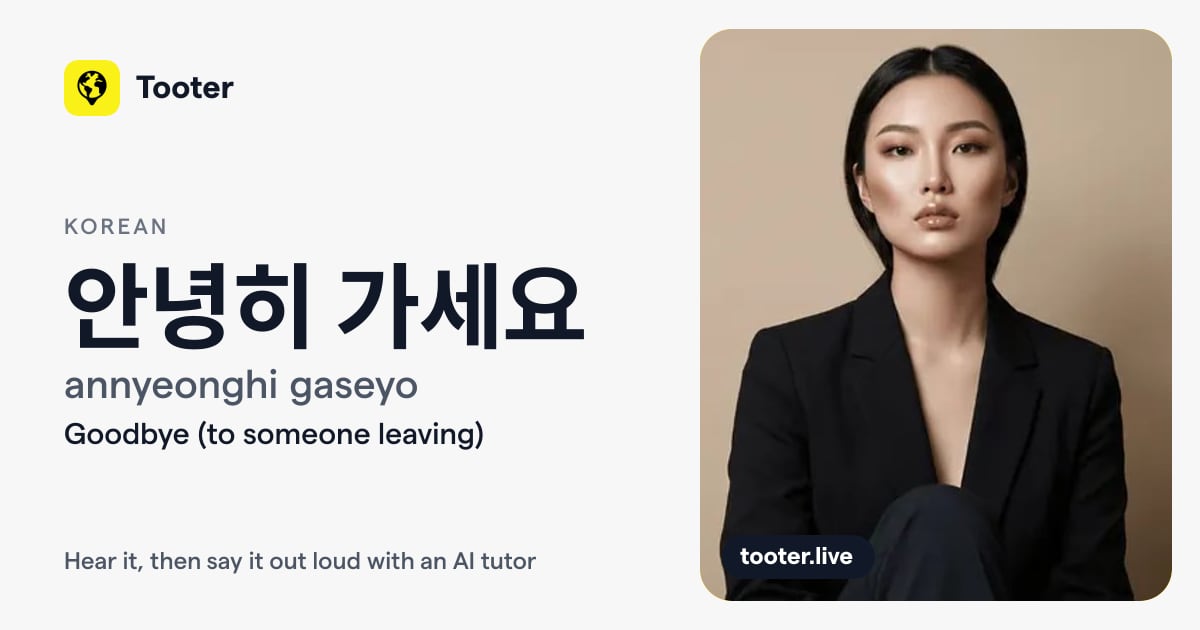
To someone who is leaving, like a customer walking out.
When you leave and the other person stays, like leaving a shop.
Very formal. Staff to customers, announcements.
Same word as casual hi. Friends and kids.
To a friend who is leaving.
To a friend who stays when you go.
Learners film their Tooter practice
Real videos from Tooter creators practicing with their tutor. Public TikTok counts, October 26, 2026.
 Learning Korean
- 9.3K likes
- 124 comments
- 912 shares
 Learning Korean
- 3K likes
- 68 comments
- 412 shares
 Learning Korean
- 3.2K likes
- 44 comments
- 367 shares
 Learning German
- 26.9K likes
- 694 comments
- 3.9K shares
 Learning Spanish
- 1.5K likes
- 31 comments
- 526 shares
 Learning Spanish
- 777 likes
- 26 comments
- 201 shares
Which Korean goodbye to use
Korean picks a goodbye by who walks away. Say 안녕히 가세요 (annyeonghi gaseyo), go in peace, to someone leaving; if you leave and they stay, it becomes 안녕히 계세요. Friends use 잘 가 instead.
| Situation | Korean | Romanization |
|---|---|---|
| They leave, you stay | 안녕히 가세요 | annyeonghi gaseyo |
| You leave, they stay | 안녕히 계세요 | annyeonghi gyeseyo |
| You both walk away | 안녕히 가세요 | annyeonghi gaseyo |
| A friend leaves | 잘 가 | jal ga |
| You leave a friend | 잘 있어 | jal isseo |
| Someone goes to bed | 안녕히 주무세요 | annyeonghi jumuseyo |
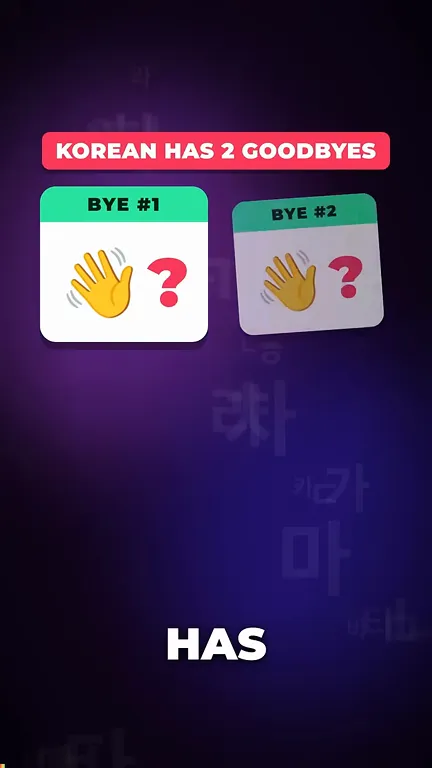
Korean has two goodbyes
안녕히 가세요 (go in peace) is for someone leaving, 안녕히 계세요 (stay in peace) for someone staying. If you both walk away, you both say 가세요.
More short lessons on Tooter's YouTube channel.
Leaving a friend's place
You are heading home after dinner at a friend's apartment.
Bye, see you and take care
After the goodbye itself, Koreans often add when they'll meet again or a wish for the way home.
- polite잘 가요jal gayoBye (to someone leaving)
The polite form of 잘 가. Friends you speak politely with, coworkers.
- polite잘 있어요jal isseoyoBye (to someone staying)
The polite form of 잘 있어.
- polite내일 봐요naeil bwayoSee you tomorrow
With friends: 내일 봐.
- polite다음에 봐요daeume bwayoSee you next time
- polite조심히 가세요josimhi gaseyoGet home safe
Very common at night or in bad weather.
- polite들어가세요deureogaseyoTake care (on your way home)
Said at the end of a call or when parting after work.
- polite연락할게요yeollakhalgeyoI'll be in touch
- casual바이바이baibaiBye-bye
Borrowed from English. Playful, common among young people.
Pick the best reply
Three goodbyes. Say each reply out loud, then pick the one that fits. Every reply is correct Korean; some just don't fit the moment.
How to pronounce 안녕히 가세요
안녕히 가세요 (annyeonghi gaseyo), the Korean goodbye to someone leaving, has six even beats: an-nyeong-hi ga-se-yo. In fast speech the h in 히 nearly disappears, so it often sounds like annyeong-i gaseyo.
가 is a soft ga
The ㄱ in 가세요 sits between an English g and k. Coming right after the vowel of 히, it sounds close to a soft g: ga-se-yo, with the voice dropping on 요.
Go versus stay
가세요 comes from 가다, to go. 계세요 comes from 계시다, the respectful form of to stay. You wish the leaver a safe trip and the stayer a peaceful stay.
Both leaving? Both say 가세요
If you part ways on the street and everyone walks off, each person says 안녕히 가세요.
Soften the h
안녕히 is an-nyeong-hi, but the h is light in fast speech, so it can sound like annyeong-i.
계 often sounds like 게
In everyday speech 계세요 is usually said ge-se-yo. Saying gye-se-yo is correct too.
Say it out loud with a Korean tutor
Lifelike AI tutors play the other person and correct you as you speak. Pick one to start.
 Minjiconversation-firstPractice with Minji
 Hanatravel-focusedPractice with Hana
 Jisooculture-richPractice with Jisoo
 Yunaconfidence-buildingPractice with Yuna
 Soranatural correctionPractice with Sora
 Jiwoofluency-drivenPractice with Jiwoo
 Nariscenario-ledPractice with Nari
 Sujinrhythm-awarePractice with Sujin
 @learningwith.emma
 @learningwith.michelle
Questions learners ask
What does jal ga mean?
잘 가 (jal ga) means bye, go well. It is casual and said to a friend who is leaving. The polite version is 잘 가요 (jal gayo).
How do you pronounce goodbye in Korean?
안녕히 가세요 is an-nyeong-hi ga-se-yo, and 안녕히 계세요 is an-nyeong-hi gye-se-yo, often said ge-se-yo. Keep the syllables even and let your voice fall at the end.
How do you say bye casually in Korean?
Say 안녕 (annyeong) or 잘 가 (jal ga) to friends. Add 나중에 봐 (najunge bwa), see you later, if you'll meet again soon.
What is the difference between annyeonghi gaseyo and annyeonghi gyeseyo?
안녕히 가세요 (annyeonghi gaseyo) is said to someone who is leaving. 안녕히 계세요 (annyeonghi gyeseyo) is said by the person leaving to someone who stays.
Can I say annyeong to say goodbye?
Yes, 안녕 (annyeong) means both hi and bye, but it's casual: use it with friends and children. Hello in Korean explains the polite 안녕하세요.
How do you say see you tomorrow in Korean?
Say 내일 봐요 (naeil bwayo), or 내일 봐 (naeil bwa) with friends. With a boss or teacher, 내일 뵙겠습니다 (naeil boepgetseumnida) is more respectful.
How do you say goodbye on the phone in Korean?
People often say 들어가세요 (deureogaseyo), roughly take care, or 끊을게요 (kkeuneulgeyo), I'll hang up now. With friends, 응, 안녕 (eung, annyeong) is enough.
Which goodbye should I use in a shop?
You are leaving and the staff stay, so say 안녕히 계세요. The staff will say 안녕히 가세요 to you. A Tooter tutor can play the shopkeeper so you can practice the switch out loud.
Say 안녕히 가세요 to a tutor today.
Answer a few quick questions, then practice out loud with a tutor.
By the Tooter Editorial Team. Updated November 23, 2026. Tooter tutors are AI characters, not human teachers. Romanization follows Revised Romanization.