 Tooter
How to say I love you in Arabic
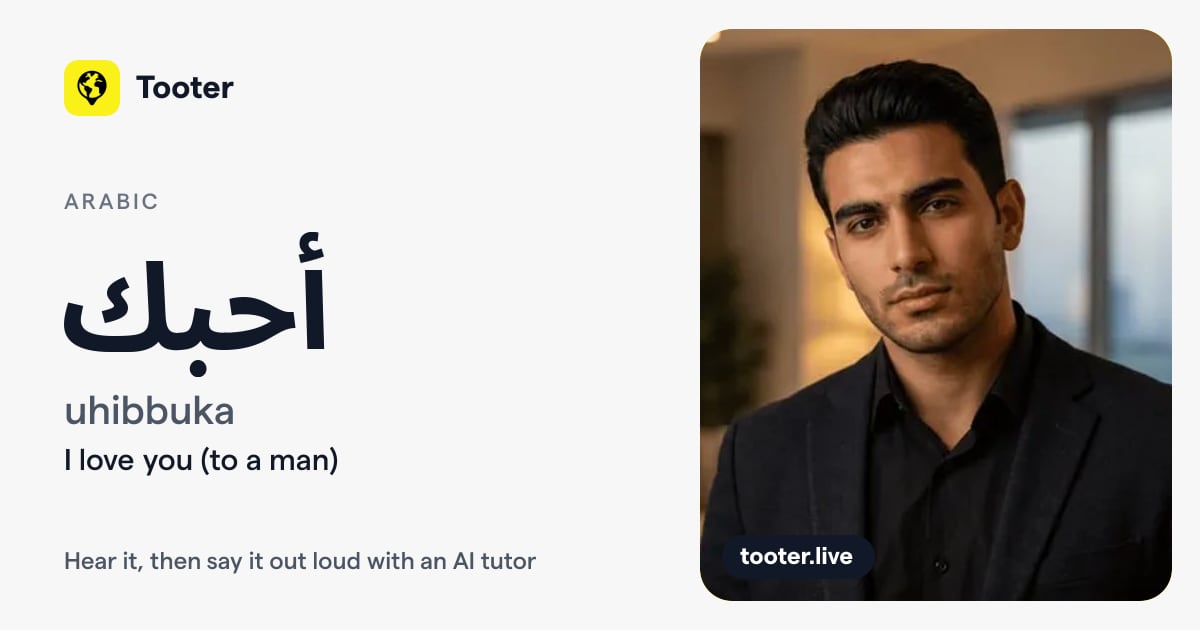
I love you in Arabic is أحبك. In Modern Standard Arabic it's uhibbuka to a man and uhibbuki to a woman. In everyday Saudi speech it's ahibbak to a man and ahibbik to a woman, and in Egypt and the Levant people say بحبك (bahibbak, bahibbik).
Practice it with a tutor Live
 Live
 Live
Who do you want to say it to?
Pick one to start your plan. It takes about a minute.
Every way to say I love you
Written Arabic uses one word, أحبك, for all of these. The vowels change with who you're talking to and where you are.
Modern Standard Arabic, as in songs, poems and writing.
The same written word, ending in i.
Everyday Saudi and Gulf speech.
Everyday Saudi and Gulf speech.
Egypt and the Levant, often written bahebak. To a woman: bahibbik.
To a woman: uhibbuki kathiran.
For a card or a letter.
To a woman: ishtaqt lik.
Which form of أحبك to use
أحبك (uhibbuka) is Arabic for I love you said to a man in Modern Standard Arabic; to a woman it becomes uhibbuki. In everyday Saudi speech, say ahibbak or ahibbik instead, and in Egypt and the Levant, bahibbak or bahibbik.
| Say | To | Where |
|---|---|---|
| uhibbuka | A man | Standard Arabic |
| uhibbuki | A woman | Standard Arabic |
| ahibbak | A man | Saudi, Gulf |
| ahibbik | A woman | Saudi, Gulf |
| bahibbak | A man | Egypt, Levant |
| bahibbik | A woman | Egypt, Levant |
Saying it back
Khalid calls you in the evening after a long day apart. This is everyday Saudi Arabic.
Love, my love and other sweet words
The word for love, and what couples and families call each other.
- politeحبhubbLove
The noun. The doubled b is held a moment.
- casualحبيبيhabibiMy love (to a man)
- casualحبيبتيhabibtiMy love (to a woman)
- casualيا عمريya 'umriMy darling (literally my life)
To a partner or a child, man or woman.
- casualيا قلبيya qalbiMy heart, sweetheart
In Saudi speech the q often sounds like g: ya galbi.
- politeأحب القهوةuhibbu al-qahwaI love coffee
The same verb means like or love for food, places and hobbies.
Pick the best reply
Three moments about love and liking. Say each reply out loud, then pick the one that fits. Every reply is correct Arabic; some just don't fit the moment.
How to pronounce أحبك in Arabic
أحبك (uhibbuka), I love you in Arabic, is said u-HIB-bu-ka, with the stress on the second syllable. The h is ح, breathy and from deep in the throat, and the doubled b is held a moment before the ending ka.
The ending shows who you love
Arabic marks the you at the end of the word: ka or ak for a man, ki or ik for a woman. Get this right and you sound careful and sincere.
The breathy h
ح in hubb and habibi is a strong, breathy h from the middle of the throat, as if you're fogging a window. It isn't the English h.
Ana is for emphasis
The verb already means I love, so ana (I) isn't needed. Add it to answer back: wa ana ahibbak, and I love you.
Love and like are one verb
Use the same verb for food, places and hobbies: uhibbu al-qahwa, I love coffee. Context tells people which you mean.
Say it out loud with an Arabic tutor
Lifelike AI tutors play the other person and correct you as you speak. Pick one to start.
 Laylatravel-focusedPractice with Layla
 Amiraculture-richPractice with Amira Noorconfidence-buildingPractice with Noor Salmanatural correctionPractice with Salma Yasminfluency-drivenPractice with Yasmin
 Hanascenario-ledPractice with Hana
 Farahrhythm-awarePractice with Farah
 Linaconversation-firstPractice with Lina
Questions learners ask
How do you say I love you in Arabic?
Say أحبك: uhibbuka to a man and uhibbuki to a woman in standard Arabic. In Saudi Arabia it sounds like ahibbak and ahibbik.
How do you say love in Arabic?
Love is حب (hubb). Someone you love is حبيب (habib), and the verb to love is أحب.
How do you say my love in Arabic?
Say حبيبي (habibi) to a man and حبيبتي (habibti) to a woman. The nuances are in habibi meaning.
What does uhibbuka mean in English?
Uhibbuka means I love you, said to a man in Modern Standard Arabic. Said to a woman it becomes uhibbuki.
How do you pronounce ana bahebak?
Say A-na ba-HEB-bak. It's Egyptian and Levantine for I love you to a man; to a woman, it's ana bahebbik.
How do you write love in Arabic?
Love is written حب, the letters ح (ha) and ب (ba). Arabic runs right to left, and a small mark called shadda over the ب doubles it.
How do you say I love you too in Arabic?
Say وأنا أحبك, literally and I love you: wa ana ahibbak to a man, wa ana ahibbik to a woman.
How can I practice saying I love you in Arabic?
Say each form out loud until the endings feel automatic. Tooter's Arabic tutors speak Saudi Arabic and can play a partner or friend, correcting your pronunciation as you speak.
Say I love you in Arabic with a tutor.
Answer a few quick questions, then practice out loud with a tutor.
By the Tooter Editorial Team. Updated November 21, 2026. Tooter tutors are AI characters, not human teachers. Romanization follows a simple English transliteration.