 Tooter
How to say sorry in Korean
To say I'm sorry in Korean, use 죄송합니다 (joesonghamnida) with strangers, elders and at work, or 미안해요 (mianhaeyo) in everyday polite speech. With close friends, say 미안해 (mianhae). For excuse me, say 실례합니다 (sillyehamnida).
Practice it with a tutor Learning Korean
- 95.6K likes
- 1.5K comments
- 20.1K shares
 Learning French
- 112.3K likes
- 1.4K comments
- 128.7K shares
 Learning Spanish
- 102.8K likes
- 737 comments
- 22.9K shares
Who do you need to apologize to?
Pick one to start your plan. It takes about a minute.
Every way to say sorry
Korean has two apology words. 죄송 is humble and respectful; 미안 is for people you are close to.
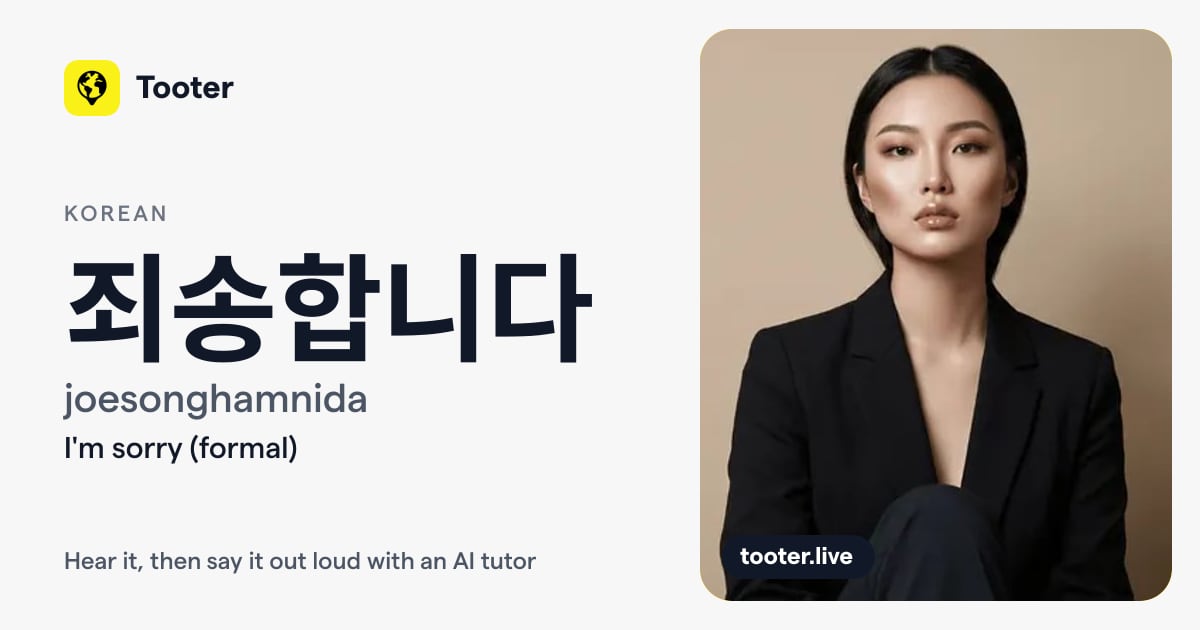
The safest apology with strangers, staff, elders and at work.
Slightly softer, still respectful.
For a real mistake, like being very late.
Polite but less humble. Good with friends' friends and people your age.
Close friends, partners and family.
A quick sorry between friends.
Before you interrupt, pass through a crowd, or enter a room.
To call a server or stop a stranger to ask something.
Learners film their Tooter practice
Real videos from Tooter creators practicing with their tutor. Public TikTok counts, October 26, 2026.
 Learning Korean
- 9.3K likes
- 124 comments
- 912 shares
 Learning Korean
- 3K likes
- 68 comments
- 412 shares
 Learning Korean
- 3.2K likes
- 44 comments
- 367 shares
 Learning German
- 26.9K likes
- 694 comments
- 3.9K shares
 Learning Spanish
- 1.5K likes
- 31 comments
- 526 shares
 Learning Spanish
- 777 likes
- 26 comments
- 201 shares
Which Korean apology to use
죄송합니다 (joesonghamnida) is the humble Korean apology for a boss, an elder, a customer or a stranger. With friends it sounds too stiff: use 미안해 (mianhae) there, and 실례합니다 when you only need to say excuse me.
| Talking to | Korean | Romanization |
|---|---|---|
| Boss, elder, customer | 죄송합니다 | joesonghamnida |
| Coworker, acquaintance | 죄송해요 | joesonghaeyo |
| Someone your age | 미안해요 | mianhaeyo |
| Close friend, partner | 미안해 | mianhae |
| Interrupting someone | 실례합니다 | sillyehamnida |
| Calling a server | 저기요 | jeogiyo |
Apologizing for being late
You arrive late to meet a friend.
What to say when someone apologizes in Korean
When someone says 죄송합니다 (joesonghamnida, I'm sorry) to you in Korean, the kind answer is 괜찮아요 (gwaenchanayo), it's okay. 아니에요 (anieyo) brushes it off, and friends just say 괜찮아.
- polite괜찮아요gwaenchanayoIt's okay
- polite아니에요anieyoNo worries, it's nothing
- polite신경 쓰지 마세요singyeong sseuji maseyoDon't worry about it
- casual괜찮아gwaenchanaIt's fine
Pick the best reply
Three moments with an apology. Say each reply out loud, then pick the one that fits. Every reply is correct Korean; some just don't fit the moment.
How to pronounce 죄송합니다
Korean sorry, 죄송합니다, is romanized joesonghamnida but sounds like jweh-song-ham-ni-da. The first vowel is a weh sound, and the ㅂ in 합 turns into an m before ㄴ.
죄 sounds like "jweh"
The vowel ㅚ is usually said like "weh" today, so 죄송 sounds like jweh-song. The romanization joe can mislead English speakers.
The b becomes an m
합니다 is said ham-ni-da, just like in 감사합니다. Altogether: jweh-song-ham-ni-da.
Name the reason first
Put the reason before the apology with -어서/-아서: 늦어서 죄송합니다 (neujeoseo joesonghamnida), sorry for being late.
Bow with it
A short bow carries much of the apology, especially with older people. A deeper bow shows more regret.
Say it out loud with a Korean tutor
Lifelike AI tutors play the other person and correct you as you speak. Pick one to start.
 Minjiconversation-firstPractice with Minji
 Hanatravel-focusedPractice with Hana
 Jisooculture-richPractice with Jisoo
 Yunaconfidence-buildingPractice with Yuna
 Soranatural correctionPractice with Sora
 Jiwoofluency-drivenPractice with Jiwoo
 Nariscenario-ledPractice with Nari
 Sujinrhythm-awarePractice with Sujin
 @learningwith.emma
 @learningwith.michelle
Questions learners ask
What does mianhae mean?
미안해 (mianhae) means I'm sorry in casual Korean. Use it with close friends, partners and family. Add 요 for the polite 미안해요 (mianhaeyo).
What does joesonghamnida mean?
죄송합니다 (joesonghamnida) is a humble, formal I'm sorry. It ends in 합니다 like 감사합니다, the formal thank you in Korean, and you'll hear it from staff in shops and on the subway.
Is it biane or mianhae?
It is 미안해 (mianhae), with an m. Korean m can sound soft at the start of a word, which is why some people hear a b, but there is no word biane.
What is the difference between mianhae and joesonghamnida?
죄송합니다 (joesonghamnida) is humble and respectful, for strangers, elders and customers. 미안해 (mianhae) is for friends and equals. When unsure, choose 죄송합니다.
How do you say sorry for being late in Korean?
Say 늦어서 죄송합니다 (neujeoseo joesonghamnida) formally, or 늦어서 미안해 (neujeoseo mianhae) to a friend. The -어서 ending gives the reason.
How do you say excuse me in Korean?
Say 실례합니다 (sillyehamnida) when you interrupt or pass by someone. To get a server's attention, say 저기요 (jeogiyo).
How do you reply to sorry in Korean?
Say 괜찮아요 (gwaenchanayo), it's okay, or 아니에요 (anieyo), it's nothing. With friends, 괜찮아 (gwaenchana) is enough.
How can I practice apologizing in Korean?
Say each apology out loud with its reason until the ending comes easily. A Tooter tutor can play a friend or a boss so you practice choosing between 미안해 and 죄송합니다.
Practice 죄송합니다 with a tutor.
Answer a few quick questions, then practice out loud with a tutor.
By the Tooter Editorial Team. Updated November 22, 2026. Tooter tutors are AI characters, not human teachers. Romanization follows Revised Romanization.