 Tooter
How to say how are you in Japanese
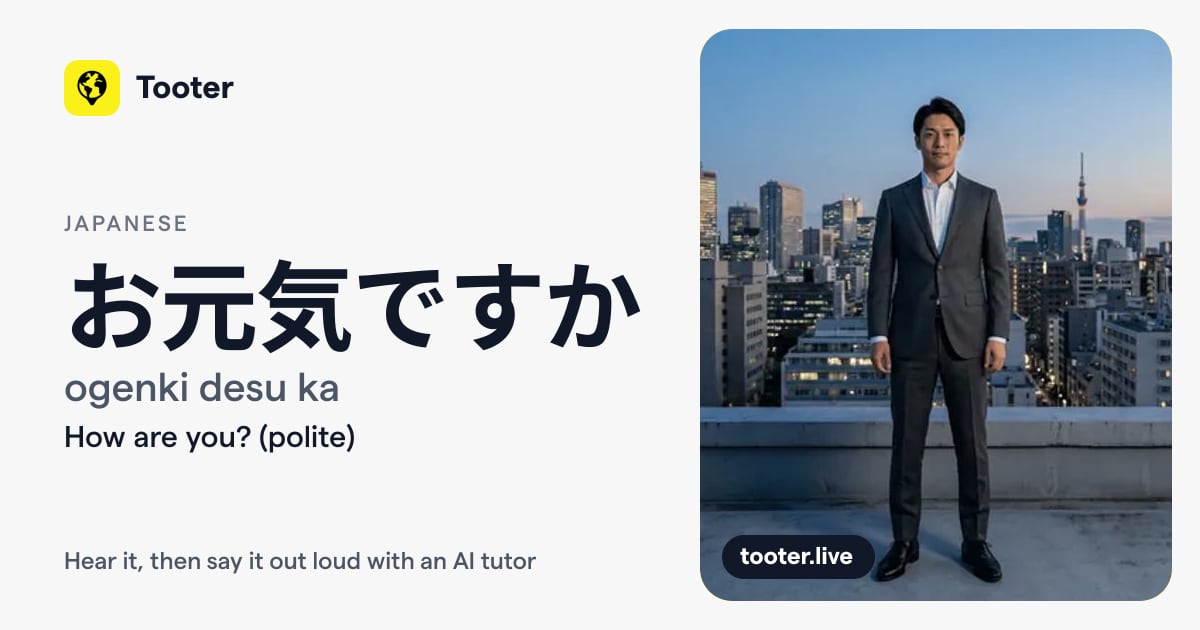
How are you in Japanese is お元気ですか (ogenki desu ka). Japanese speakers don't ask it every day the way English speakers do; it's for someone you haven't seen in a while. With friends, say 元気? (genki?) or 最近どう? (saikin dō?). The usual answer is 元気です (genki desu), I'm fine.
Practice it with a tutor Learning Japanese
- 43 likes
- 2 comments
- 9 shares
 Learning French
- 112.3K likes
- 1.4K comments
- 128.7K shares
 Learning Spanish
- 102.8K likes
- 737 comments
- 22.9K shares
Who will you catch up with?
Pick one to start your plan. It takes about a minute.
Every way to ask how are you
Japanese has no all-purpose how are you for every meeting. Pick the question by how long it's been and how close you are.
After a long time apart, or at the start of a letter or email.
Catching up with a friend after weeks or months.
The everyday check-in between friends. Kana: さいきんどう.
The same check-in, polite enough for coworkers.
About health, work or a project. Kana: ちょうしはどう.
When someone looks unwell or something went wrong. Not a greeting.
Literally no changes? For elders, clients and business emails. Kana: おかわりありませんか.
Learners film their Tooter practice
Real videos from Tooter creators practicing with their tutor. Public TikTok counts, October 26, 2026.
 Learning Korean
- 95.6K likes
- 1.5K comments
- 20.1K shares
 Learning German
- 26.9K likes
- 694 comments
- 3.9K shares
 Learning Korean
- 9.3K likes
- 124 comments
- 912 shares
 Learning Spanish
- 1.5K likes
- 31 comments
- 526 shares
 Learning Korean
- 3K likes
- 68 comments
- 412 shares
 Learning Korean
- 3.2K likes
- 44 comments
- 367 shares
Which Japanese how are you to use
お元気ですか (ogenki desu ka, how are you?) is the polite Japanese question for someone you haven't seen in a while, or the opening of a letter. Asked of people you see daily it sounds odd; friends catch up with 元気だった? (genki datta) or 最近どう? (saikin dō).
| Japanese | Romaji | Use it |
|---|---|---|
| お元気ですか | ogenki desu ka | Not seen in a while |
| 元気だった? | genki datta? | Friends, after a while |
| 最近どう? | saikin dō? | Casual check-in |
| 調子はどう? | chōshi wa dō? | Health, work, projects |
| 大丈夫ですか | daijōbu desu ka | Someone looks unwell |
| お変わりありませんか | okawari arimasen ka | Elders, business |
Catching up with an old friend
You run into your friend Kenji at the station. You haven't seen each other in months.
How to answer how are you in Japanese
The usual answer to お元気ですか (ogenki desu ka, how are you?) in Japanese is 元気です (genki desu), "I'm fine". おかげさまで、元気です (okagesama de, genki desu) is warmer and more modest; then ask back with the person's name and は.
- polite元気ですgenki desuI'm fine
- casual元気だよgenki da yoI'm good
- politeおかげさまで、元気ですokagesama de, genki desuI'm well, thank you
Okagesama de means thanks to you. A modest, warm answer.
- politeまあまあですmā mā desuSo-so
- polite相変わらずですaikawarazu desuSame as always
Kana: あいかわらずです.
- politeちょっと疲れていますchotto tsukarete imasuI'm a bit tired
- polite田中さんは?tanaka-san wa?And you, Ms. Tanaka?
Ask back with their name plus は.
Pick the best reply
Three people check on you. Say each reply out loud, then pick the one that fits. Every reply is correct Japanese; some just don't fit the moment.
How to pronounce お元気ですか
Japanese お元気ですか (ogenki desu ka, how are you?) sounds like o-gen-ki des ka: a hard g as in "get", a barely voiced u in desu, and a slight lift on the final ka that marks the question.
Ogenki has a hard g
お元気 is o-gen-ki. The g is hard, as in "get", never soft as in "gentle", and the n gets its own short beat before ki.
Lift the ka
か turns the sentence into a question. Let your voice rise a little on it, the way English questions rise at the end.
Not an everyday greeting
With people you see daily, skip how are you and greet with おはようございます or お疲れ様です instead. Save お元気ですか for real catching up.
Use names, not anata
To ask back, say the person's name with さん and は: 田中さんは? あなたは? sounds distant or even cold.
Whisper the u
In desu and in the ending of tsukarete imasu, the u is barely voiced. Say des ka, not de-su ka.
Okagesama de
This answer thanks the other person, and everyone around you, for your being well. It's polite and very natural with elders and clients.
Say it out loud with a Japanese tutor
Lifelike AI tutors play the other person and correct you as you speak. Pick one to start.
 Yukirhythm-awarePractice with Yuki
 Hanaconversation-firstPractice with Hana
 Aikotravel-focusedPractice with Aiko
 Meiculture-richPractice with Mei
 Sakuraconfidence-buildingPractice with Sakura
 Rinnatural correctionPractice with Rin
 Emifluency-drivenPractice with Emi
 Haruculture-richPractice with Haru
 @brittslowlyfluent
 @learningwith.emma
Questions learners ask
How do you say how are you in Japanese?
Say お元気ですか (ogenki desu ka) to someone you haven't seen in a while. With friends, 元気? (genki?) or 最近どう? (saikin dō?) is more natural.
What does ogenki desu ka mean?
It literally asks are you healthy and full of energy? In practice it means how are you, and it suits a reunion, a phone call or a letter.
How do you answer ogenki desu ka?
Say はい、元気です (hai, genki desu), or more politely おかげさまで、元気です. Then ask back with the person's name and は.
Is it strange to ask ogenki desu ka every day?
Yes. It implies you haven't seen the person in a while. For daily greetings, use the time-of-day greetings in hello in Japanese.
How do you say how are you casually in Japanese?
Say 元気? (genki?) to a friend you haven't seen lately, or 最近どう? (saikin dō?), how's it going?
How do you ask are you OK in Japanese?
Say 大丈夫ですか (daijōbu desu ka), or 大丈夫? with friends. It's for when someone looks unwell or something has gone wrong.
How do you say and you in Japanese?
Use the person's name with は: 田中さんは? (tanaka-san wa?). Japanese speakers rarely say あなた (you) to someone they know.
How can I practice small talk in Japanese?
Practice asking and answering out loud, switching between polite and casual forms. Tooter's Japanese tutors can play an old friend or coworker and correct you as you speak.
Practice Japanese small talk with a tutor.
Answer a few quick questions, then practice out loud with a tutor.
By the Tooter Editorial Team. Updated November 21, 2026. Tooter tutors are AI characters, not human teachers. Romanization follows Hepburn romanization.