 Tooter
How to say good evening in Japanese
Good evening in Japanese is こんばんは (konbanwa), the greeting for anyone you meet after dark. It is polite enough for strangers, hosts and coworkers. The final は is read wa. Konbanwa only greets, so when you part at night, say おやすみなさい (oyasuminasai) instead.
Practice it with a tutor Learning Japanese
- 43 likes
- 2 comments
- 9 shares
 Learning French
- 112.3K likes
- 1.4K comments
- 128.7K shares
 Learning Spanish
- 102.8K likes
- 737 comments
- 22.9K shares
Who will you greet this evening?
Pick one to start your plan. It takes about a minute.
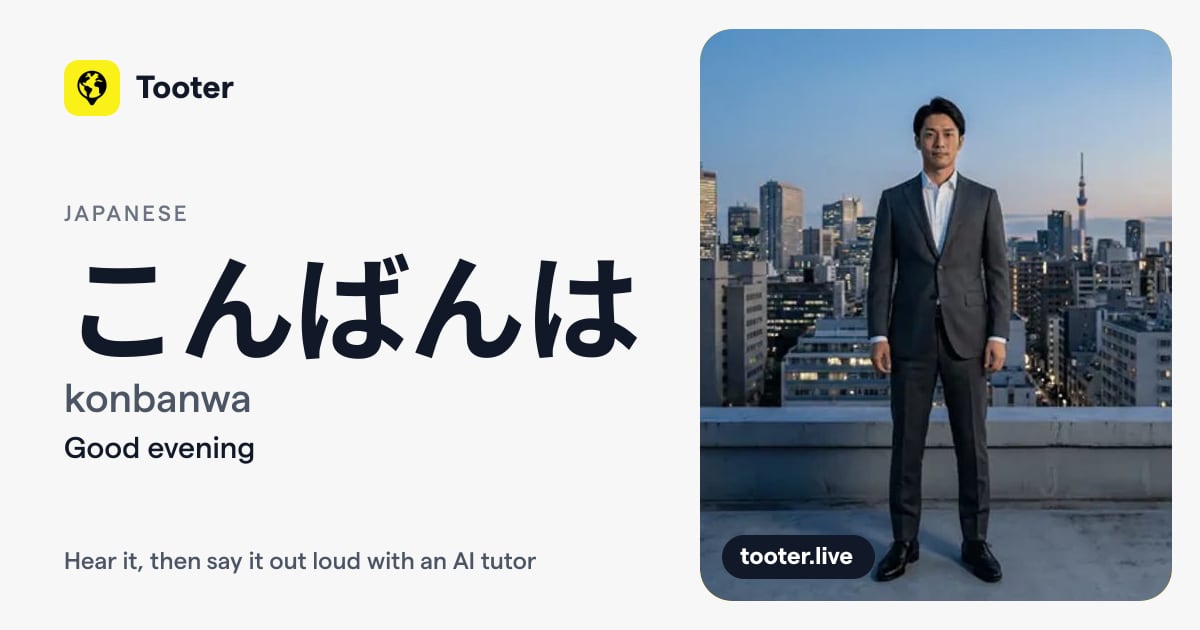
Every way to say good evening in Japanese
Japanese has one evening greeting, こんばんは, and a few set phrases that do its job at work, on stage or on the phone late at night.
For neighbors, shop staff, hosts and anyone you meet after dark.
How hosts, teachers and speakers open an evening show, class or event.
A friendly greeting for someone you know a little, like a neighbor.
Opens a late phone call or visit, usually after about 9 p.m.
Coworkers and classmates greet each other with this instead of konbanwa.
The friendly version for close coworkers and friends at the end of the day.
The same greeting written in kanji, seen in older or formal writing. It sounds exactly like こんばんは.
Learners film their Tooter practice
Real videos from Tooter creators practicing with their tutor. Public TikTok counts, October 26, 2026.
 Learning Korean
- 95.6K likes
- 1.5K comments
- 20.1K shares
 Learning German
- 26.9K likes
- 694 comments
- 3.9K shares
 Learning Korean
- 9.3K likes
- 124 comments
- 912 shares
 Learning Spanish
- 1.5K likes
- 31 comments
- 526 shares
 Learning Korean
- 3K likes
- 68 comments
- 412 shares
 Learning Korean
- 3.2K likes
- 44 comments
- 367 shares
When to say こんばんは in Japanese
こんばんは (konbanwa) means good evening in Japanese and greets anyone you meet once it gets dark. Earlier in the day the greeting changes, coworkers often use otsukaresama desu instead, and when you part at night konbanwa is replaced by oyasuminasai.
| When | Japanese | Romaji |
|---|---|---|
| Morning | おはようございます | ohayō gozaimasu |
| Daytime | こんにちは | konnichiwa |
| After dark | こんばんは | konbanwa |
| Coworkers, evening | お疲れ様です | otsukaresama desu |
| Late call or visit | 夜分遅くにすみません | yabun osoku ni sumimasen |
| Parting at night | おやすみなさい | oyasuminasai |
Arriving at an evening language exchange
You walk into a language exchange at a cafe after work. Ren is one of the organizers.
How to reply to こんばんは in Japanese
When someone greets you with こんばんは (konbanwa, good evening) in Japanese, the usual reply is simply konbanwa back, with a small nod. With a neighbor you can add a line about the weather, and with coworkers you can add otsukaresama desu.
- politeこんばんはkonbanwaGood evening
Say it right back. This is the reply nine times out of ten.
- politeあ、こんばんはa, konbanwaOh, good evening
When someone greets you first, like a neighbor in the hallway.
- politeこんばんは、寒いですねkonbanwa, samui desu neGood evening, cold, isn't it?
Weather is the classic small talk with neighbors. In summer, swap in 暑い (atsui, hot).
- politeこんばんは、お疲れ様ですkonbanwa, otsukaresama desuGood evening, good work today
For a coworker or classmate you meet in the evening.
- casualどうもdōmoHi
A quick reply with a nod when you just pass someone you know.
Pick the best reply
Three people speak to you in the evening. Say each reply out loud, then pick the one that fits. Every reply is correct Japanese; some just don't fit the moment.
How to pronounce こんばんは
こんばんは (konbanwa), Japanese for good evening, has five even beats: ko, n, ba, n, wa. Each ん is a full beat, the first one sounds like m because a b follows, and the final は is read wa, never ha.
Five beats, not two
English ears hear kon-ban-wa, but Japanese counts ko, n, ba, n, wa. Hold each ん for a full beat, the same length as the others, with a fairly flat pitch.
The first n becomes m
Before b, your lips close for the ん, so konban sounds close to kombahn. Don't force a clear n; let it blend into the b.
Why it's written は
Konbanwa started as konban wa, as for this evening, the opening of a longer greeting. は is the topic particle, read wa. The spelling こんばんわ shows up in casual texts, but it's nonstandard.
Switch when it gets dark
There's no fixed hour. Move from konnichiwa to konbanwa as it gets dark, earlier in winter and later in summer. Indoors at night, konbanwa is always right.
Say it out loud with a Japanese tutor
Lifelike AI tutors play the other person and correct you as you speak. Pick one to start.
 Yukirhythm-awarePractice with Yuki
 Hanaconversation-firstPractice with Hana
 Aikotravel-focusedPractice with Aiko
 Meiculture-richPractice with Mei
 Sakuraconfidence-buildingPractice with Sakura
 Rinnatural correctionPractice with Rin
 Emifluency-drivenPractice with Emi
 Haruculture-richPractice with Haru
 @brittslowlyfluent
 @learningwith.emma
Questions learners ask
How do you say good evening in Japanese?
Say こんばんは (konbanwa). It works with anyone you meet after dark, from a neighbor to a hotel clerk.
What time do you start saying konbanwa?
When it starts getting dark, which is earlier in winter than in summer. Before that, say こんにちは; you can see the daytime greetings on hello in Japanese.
Why is konbanwa spelled with は and not わ?
The greeting began as 今晩は, as for this evening, where は is the topic particle. The particle は is always read wa, so the spelling kept は.
Can I say konbanwa when I leave?
No. Konbanwa only greets. When you part at night, say おやすみなさい (oyasuminasai), as on good night in Japanese, or また明日 (mata ashita) if you'll meet tomorrow.
How do you reply to konbanwa?
Say konbanwa back with a small nod. With a neighbor you can add 寒いですね (samui desu ne, cold, isn't it?).
Do Japanese friends say konbanwa to each other?
Not often in person. Close friends tend to say お疲れ (otsukare) or start talking, and konbanwa can feel a little formal between them.
What does konban mean in Japanese?
今晩 (konban) means this evening or tonight. You'll hear it in other phrases too, like 今晩は忙しい? (konban wa isogashii?, are you busy tonight?).
How can I practice Japanese evening greetings?
Greet people out loud in role plays: a neighbor, a coworker, a late phone call. Tooter's Japanese tutors play roles like these and correct your pronunciation as you speak.
Greet people in Japanese with a tutor.
Answer a few quick questions, then practice out loud with a tutor.
By the Tooter Editorial Team. Updated November 26, 2026. Tooter tutors are AI characters, not human teachers. Romanization follows Hepburn romanization.