Tooter
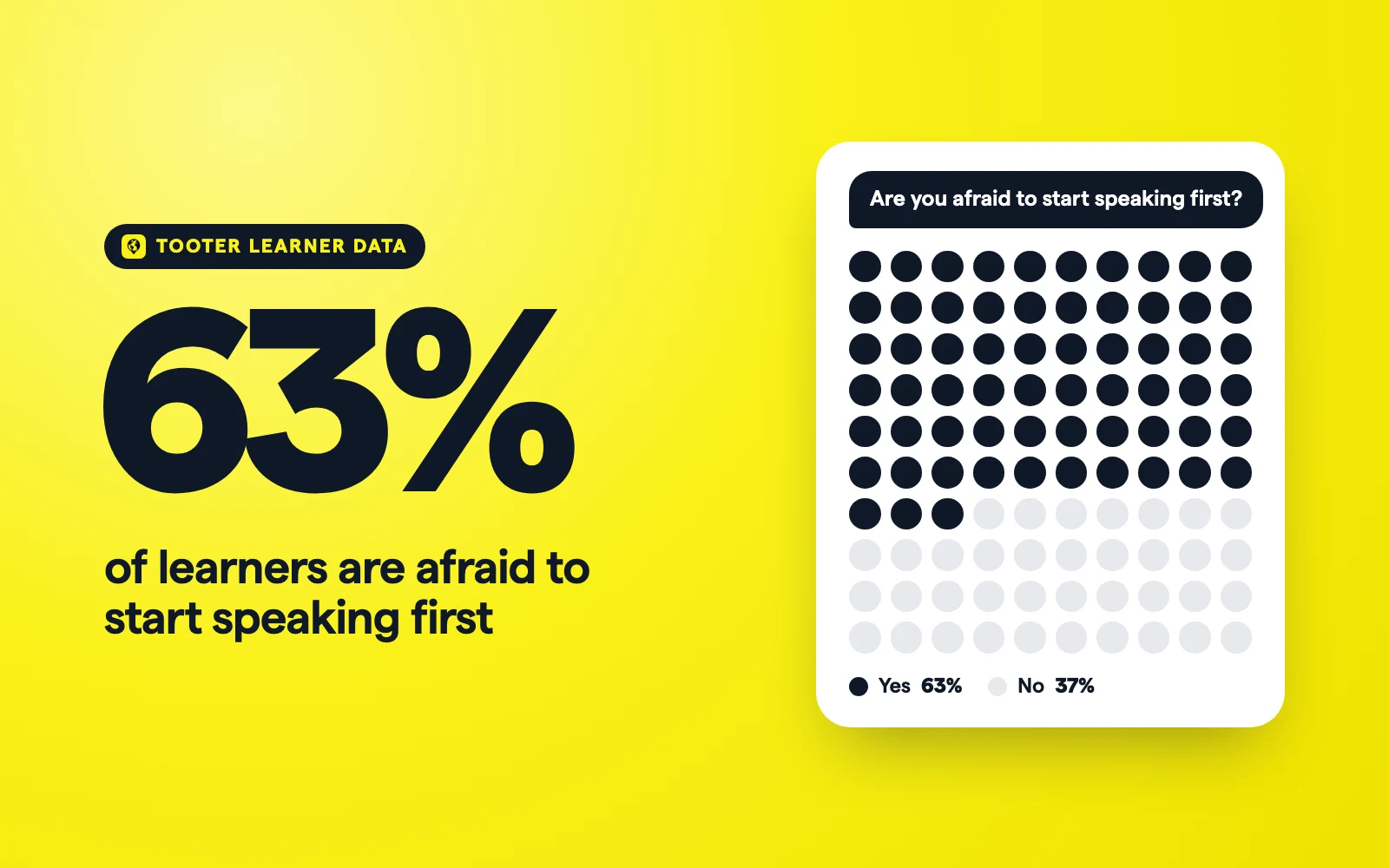
63% of people who start learning a language with Tooter say they're afraid to start speaking first. We looked at the answers learners gave in the Tooter app before their first lesson, from March to October 2026, to see who feels that fear, how it relates to ability, and what learners ask their tutors to do about it. The short version: the fear is common, it doesn't fade when ability arrives, and nervous learners still want to be corrected.
- 63% of learners are afraid to speak first.
- Getting better doesn't fix it. Learners who can hold a conversation are just as afraid.
- Most can introduce themselves, but only 34% can keep a conversation going for 5 minutes.
- Nervous isn't fragile: 98% still want their pronunciation corrected.
63% are afraid to start speaking first
Tooter's onboarding asks every new learner: "Are you afraid to start speaking first?" 63% tap Yes. There is no preselected answer, and learners answer before they have spoken to a tutor.
- 63%are afraid to start speaking first
- 77%rate themselves nervous or below
- 5%feel very confident speaking aloud
A second question asks "How confident do you feel speaking aloud?" 29% answer Nervous, 22% Very nervous, and 26% I can't speak at all. Only 18% say Somewhat confident and 5% Very confident. Put together, 77% of learners start out nervous or below.
The two answers mostly agree, with one surprise. 81% of very nervous learners are afraid to start first, which is expected. But so are 23% of learners who call themselves very confident. Being confident in your speaking and being comfortable going first are not the same thing.
Share of learners who answered Yes, grouped by their answer to "How confident do you feel speaking aloud?"
The fear doesn't fade when ability arrives
We expected fear to fall as ability rose. Mostly, it doesn't. Learners who say they can maintain a 5-minute conversation on a familiar topic are slightly more likely to be afraid to start (65%) than learners who can't (62%). Learners who said yes to all three ability questions (introducing themselves, holding a 5-minute conversation, and understanding native speakers at normal speed) were afraid 67% of the time, against 60% for learners who said no to all three.
"All three" means introducing yourself, holding a 5-minute conversation, and understanding native speakers at normal speed.
Self-described CEFR level tells the same story. Among learners who describe themselves at A0, A1, or A2, between 63% and 65% are afraid to speak first. The share only drops at B1 (52%) and B2 (45%). Even at upper intermediate, close to half still hesitate before going first.
- A0New63%
- A1Basic65%
- A2Short chats63%
- B1Everyday52%
- B2Fluent45%
From A0 ("I'm completely new to this language") to B2 ("I can talk fluently with native speakers").
One likely reason: knowing more raises the stakes. A complete beginner expects to stumble, while an intermediate speaker can hear exactly what they're getting wrong. Researchers have described foreign language anxiety as its own kind of anxiety, separate from general shyness, tied to communicating in a language you don't fully control.
Source: Horwitz, Horwitz & Cope (1986), Foreign Language Classroom Anxiety, The Modern Language Journal
The gap between hello and a real conversation
54% of learners say they can comfortably introduce themselves in the language they're learning. Only 34% can maintain a 5-minute conversation on a familiar topic, and 35% can understand native speakers talking at normal speed.
of learners are afraid to start speaking first
Among learners who can introduce themselves, only about half (52%) can keep a conversation going for 5 minutes. That is the wall most learners hit: the rehearsed opening works, then the other person replies with something unscripted.
This gap is about speaking and listening in real time, not about knowing more words. It is also the part of a language that tapping, matching, and reading exercises practice least, which is why we think you should learn a language by speaking, even in five-minute sessions.
Afraid, but not fragile: nervous learners want corrections
98% of learners want pronunciation corrections from their tutors, and 94% want tutors to challenge them in conversations. Learners who are afraid to speak first answer almost exactly the same way: 98% and 94%.
- 98%want pronunciation corrections
- 94%want tutors to challenge them
- 16%of fearful learners ask for soft feedback
Asked to choose a feedback style, 59% pick Balanced, 27% Strict, and 14% Soft. Among learners who are afraid to speak first, Soft rises only to 16%. Most nervous learners aren't asking to be protected from their mistakes. They're asking for somewhere it feels safe to make them.
That matches research on willingness to communicate, which treats the decision to speak as separate from the ability to speak, shaped by confidence and anxiety in the moment.

Who is most afraid to speak?
Women are more likely than men to say they're afraid to start speaking first (68% vs 57%), and men are more likely to ask for strict feedback (32% vs 22%). Learners under 25 are the most afraid (65%) and learners 45 and over the least (59%).
- 68%of women are afraid to speak first
- 57%of men are afraid to speak first
- 71%of native Korean speakers, the highest
By the language being learned, English learners are the most afraid (68%), even though they also report the most ability: 54% of them can hold a 5-minute conversation. Korean (65%), Chinese (64%), Japanese (62%), and French (61%) follow, then Spanish (59%) and German (53%). By native language, Korean speakers are the most afraid to speak first (71%).
Goals with more at stake come with more fear. 69% of learners heading to study abroad and 67% of learners learning for dating are afraid to speak first, against 60% of those learning for personal development. Among learners whose dream is passing an exam or a job interview, it's 68%.
Feelings about AI tutors line up too. Learners who describe themselves as "cautious but willing to try" are afraid to speak first 73% of the time, the highest of any answer to that question.
What learners ask for instead
82% of learners prefer casual conversations to a structured plan, though a little structure helps: see how guided lessons lead into live conversation. 61% care more about speaking clearly and being easy to understand than about sounding like a native speaker (39%), and learners who choose clear communication are more likely to be afraid to speak first (66% vs 59%).
Most aren't in a hurry either. "No rush" is the most common pace (34%). The share afraid to speak first is the same, 63%, whatever pace learners pick, so the fear isn't coming from deadlines.
- 82%prefer casual conversation to a structured plan
- 61%would rather be clear than sound native
- 34%picked "No rush" for their pace
If you're afraid to speak a new language
You're in the majority. Going first scares nearly two in three people starting a language, and close to half of upper-intermediate learners.
Don't wait for ability to fix it. In this data, learners who can already hold a conversation are just as afraid as those who can't. The fear eases by going first in conversations where little is at stake, again and again, not by studying until you feel ready. Start with phrases you'll really use: our language guides cover the basics in Korean, Spanish, Japanese, French, and German.
Ask for corrections anyway. Nervous learners want them as much as anyone. One correction at a time, followed by a retry, keeps them useful instead of overwhelming.
Aim to be clear, not perfect. Most learners already do: being easy to understand is the goal for 61% of them.
Tooter is built around these answers. Your first session is a chat in your own language about your goals and what makes you nervous, your tutor tracks your confidence alongside your mistakes, and it gives one fix at a time before you try again. See how it works, meet the tutors, or warm up with guided lessons first.
About this data
These figures come from the onboarding questions in the Tooter app, answered by learners who signed up between March and October 2026, before their first lesson. Each question needs a tap and has no preselected answer. Percentages are the share of learners who answered that question, and group comparisons only include groups large enough to be stable. Data was pulled on October 29, 2026.
Ability and level are self-reported, and everyone here had already chosen to download a language app, so these numbers describe people starting to learn a language with Tooter rather than all language learners. We publish percentages only, never individual answers.
Tooter's AI tutors start with a chat in your own language, track your confidence, and correct one thing at a time.
Start speaking practice